

How to Build a Personal Brand Strategy as a Wellness Entrepreneur: Step by Step
You Are Posting. You Are Growing. So Why Does It Not Convert?
You have a content strategy. You post regularly. You get some engagement. The numbers are moving slowly, but moving. And still. When it is time to sell, the silence is loud.
This is one of the most common problems I hear from wellness entrepreneurs-coaches, retreat leaders, yoga teachers, healers, who reach out for help with their visibility. They are doing everything right on paper. And it is still not working.
The problem is not effort. It is not even consistency.
The problem is that most wellness entrepreneurs are optimizing for the wrong thing.
The Visibility Trap Most Wellness Entrepreneurs Fall.
Here is what "build your personal brand" typically looks like in practice:
Post more content, more often
Chase followers and reach
Compare yourself to bigger accounts in your niche
Add more value, more tips, more education
It sounds logical. More visibility means more people see you. More people means more clients.
Except it does not work that way.
The data backs this up. According to a 2024 study by Edelman and LinkedIn, more than 75% of decision-makers say that a piece of thought leadership content led them to research a product or service they were not previously considering. But here is the thing, they are not responding to volume. They are responding to clarity and credibility.
I have seen wellness accounts with 500 followers close clients consistently. And accounts with 50,000 followers who cannot sell a single retreat spot.
The difference is not size. It is not frequency.
It is clarity.
Why Trust Is the Only Metric That Actually Matters
In the wellness space especially, trust is everything.
People are sharing their mental health struggles, their body image, their trauma, their desire to change their life. They are not handing that to someone they vaguely recognize. They hand it to someone they trust.
The numbers are clear. According to a 2024 PwC Trust Survey, 93% of business executives agree that the ability to build and maintain trust directly improves the bottom line. And according to Capital One Shopping Research, 71% of U.S. consumers are likely to buy again from brands they trust, compared to only 12% of those who do not.
For wellness entrepreneurs specifically, the stakes are higher. Your audience is not buying a software tool. They are buying transformation. That requires trust first, visibility second.
And yet most wellness entrepreneurs build their strategy in reverse.
What Actually Makes a Personal Brand Work for Wellness Entrepreneurs
When I work with founders and wellness entrepreneurs on their visibility, one pattern shows up every single time.The ones who grow in a sustainable, real way are not the biggest ones in the room.They are the clearest. The most consistent. The most recognizable.
Not recognizable as in famous. Recognizable as in: you know exactly what they stand for, how they think, and what they help with, before they say a single word about their offer.
That is the shift.
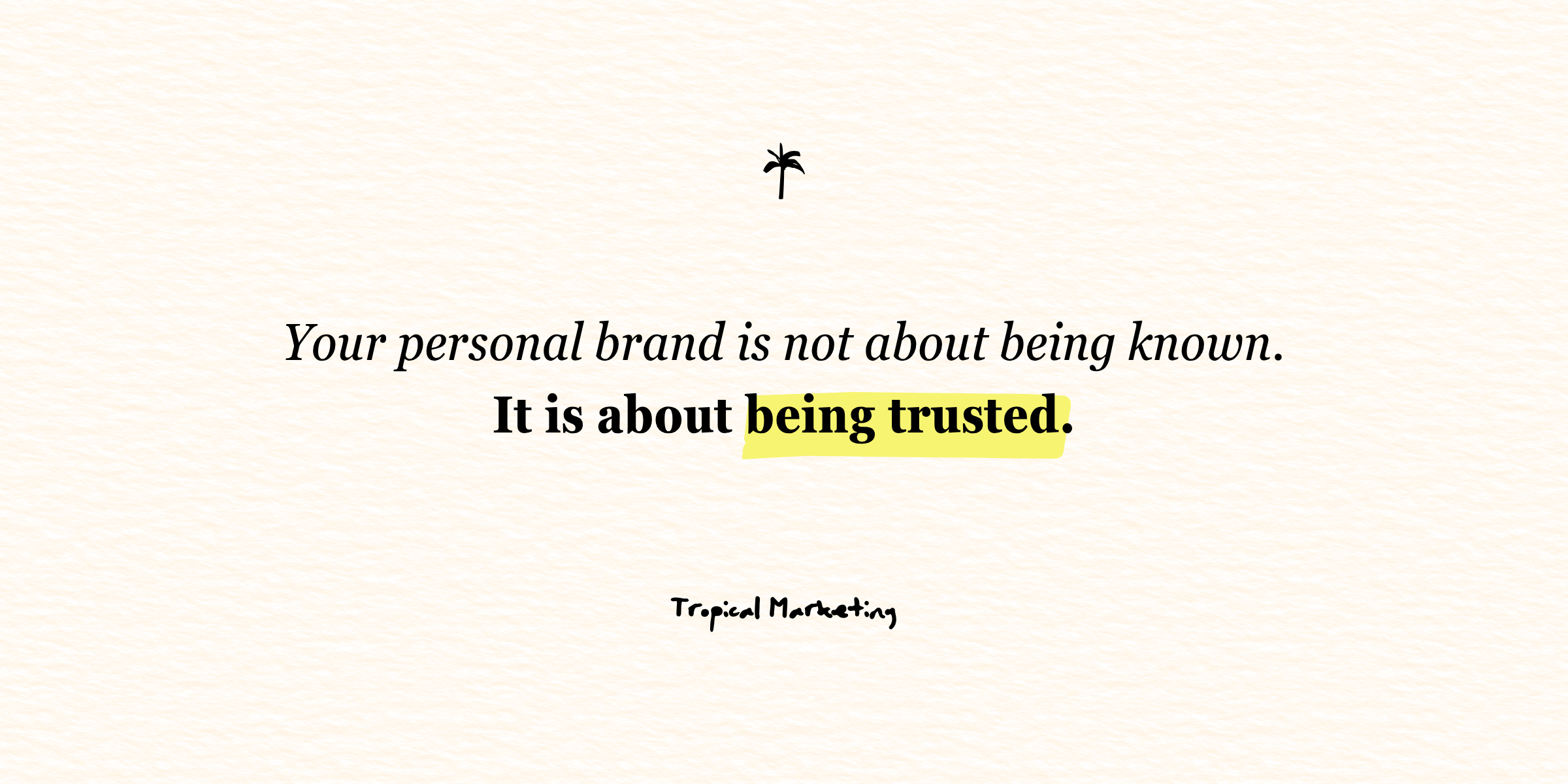
Your personal brand is not about being known. It is about being trusted.
Research from Brand Builders Group confirms this: founders and creators with strong niche authority personal brands see conversion rates 3 to 7 times higher than traditional corporate marketing. Not because they post more. Because their message is sharper and their identity is clearer.
The Question That Changes Everything
Try this right now.
Would someone recognize your voice, your perspective, your way of thinking without seeing your name on the post? If the answer is not a clear yes, that is your bottleneck. Not your posting frequency. Not your hashtags. Not your Canva templates.
Your message is not clear enough yet.
People do not follow you because you give good information. There is infinite information online, free, on every wellness topic imaginable. People follow you because they feel something consistent when you show up. They know what to expect from you. They trust that you see the world in a specific way and that way resonates with them.
That consistency, that clarity, that recognizable point of view, that is what converts over time.
Why This Matters Even More Right Now in the Wellness Space
The wellness industry reached $5.6 trillion globally in 2022, with a projected growth rate of 5.7% through 2027 (Global Wellness Institute). The space is enormous. And it is getting louder every year.
In an industry full of coaches, retreats, and healers all saying variations of the same thing : "transform your life," "find your balance," "step into your power", generic visibility is not just ineffective. It is expensive. You are spending time and energy on content that blends into the background.
According to research from Gitnux, 45% of wellness consumers aged 18 to 34 now prioritize brands with authentic storytelling in their marketing decisions. They are not looking for the most polished account. They are looking for the most real one.
And in a world where AI…
… is generating content at scale, generic messaging is becoming worthless faster than most people realize. The only thing AI cannot replicate is your specific voice, your experience, and your lived perspective.
The wellness entrepreneurs who will win the next few years are not the ones who publish the most. They are the ones who are most unmistakably themselves.
How to Build a Personal Brand Strategy as a Wellness Entrepreneur: Step by Step
This is not a theory. Here is how to actually do it.
Step 1: Define your one clear point of view
Not a niche. A perspective. A specific way of seeing your industry, your clients, their problem :that is yours alone.
Ask yourself: what do I actually believe about [your topic] that most people in my industry get wrong?
Your honest answer to that question is the foundation of your brand. Everything else builds on top of it.
For example: "Most wellness coaches tell you to do more. I believe the problem is almost always doing too much of the wrong things." That is a point of view. It is specific, it is debatable, and it will attract the right people and repel the wrong ones. Both outcomes are good.
Step 2: Build a consistent voice, not a tone guide
A tone guide is corporate. A voice is personal.
Your voice is the way you actually think and speak, translated into content. Short sentences if that is how your mind works. Specific examples instead of vague inspiration. Saying the uncomfortable truth when it is true.
Consistency here does not mean posting at the same time every Tuesday. It means that someone who reads your post from six months ago and your post from today would recognize it as the same person, same worldview, same language, same honesty.
Step 3: Name the exact problem your ideal client has, precisely
Not their category. Their specific, real, sometimes embarrassing problem.
Not "you want to feel more aligned." That is too vague.
Something like: "You have built a following, you are posting, people say they love your content and you still have months where no one signs up." That lands because it is specific. The more precisely you name the problem, the more your ideal client thinks: this person is talking about me.
And that feeling “of being genuinely understood” is what moves people to act.
Step 4: Audit your current visibility before producing more content
Read your last ten posts or pieces of content. Ask: is there a clear, consistent point of view across all of them? Or does it feel scattered, tips here, inspiration there, personal story somewhere else?
If it feels scattered to you, that is how it feels to your audience too.
Most wellness entrepreneurs try to fix their content calendar when what actually needs fixing is upstream: the message itself. What you say matters more than how often you say it.
A Simple Way to Check Your Current Visibility Right Now
If you want a fast, concrete diagnosis of where your brand stands, I put together a free 5-minute audit that shows you exactly why your content is not bringing clients.
No fluff. Just the questions that actually matter so you can see clearly where the gap is and what to work on first
Take the free 5-min Visibility Audit here →
Ready to Do This Properly?
If you want to build a message that is clear, a voice that is recognizable, and a visibility strategy that actually feeds your wellness business, that is exactly what Spark Club is built for.
Spark Club is where wellness entrepreneurs and founders do the real work of personal branding: not more content, but better decisions about what you say, how you say it, and who you say it to.
[Learn more about Spark Club →]
Frequently Asked Questions
Do I need a large audience to have a strong personal brand as a wellness entrepreneur?
No. Audience size is not the same as brand strength. A small, clear, consistent brand converts better than a large, scattered one. The research from Brand Builders Group shows that niche personal brands see 3 to 7 times higher conversion rates than traditional marketing and that applies at any audience size. What matters is that the right people find you and immediately understand what you do and who you help.
How long does it take to build a personal brand strategy that converts?
There is no universal timeline, but clarity comes faster than most people think when you focus on the right things. Most wellness entrepreneurs who struggle to convert have a message problem, not a time problem. Refining your point of view and your language around your client's real problem can shift your conversion rate within a few weeks of consistent application.
What is the biggest mistake wellness entrepreneurs make with their personal brand?
Trying to appeal to everyone. The more broadly you position yourself "I help people live better" , the less anyone feels you are speaking to them. Specificity is not a limitation. It is what makes you feel like the obvious choice for a specific person with a specific problem.
Is it possible to have a strong personal brand without showing my face or being on video?
Yes. Personal brand is about your voice, your perspective, and your consistency, not your format. Some of the clearest personal brands operate primarily through writing. That said, in the wellness space, showing up in some human form (voice, face, live content) tends to build trust faster because your clients are trusting you with something personal.
How do I know if my personal brand is actually working?
The clearest signal is not follower growth. It is recognition. When people DM you saying "your post described exactly what I am going through" or "I knew this was yours before I saw your name", that is a brand working. Conversion from a small audience is another strong signal. If you are getting inquiries and sales from a modest following, your brand is doing what it is supposed to do.
What is Spark Club and how does it help with personal brand strategy?
Spark Club is a program for founders and wellness entrepreneurs who want to build visibility that actually converts. The focus is on message clarity, brand voice, and visibility decisions , not more content production. It is designed for people who are already working hard and want to make sure that work is pointed in the right direction.
The One Thing Worth Remembering
More content is not the answer to being invisible.
Clarity is.
The wellness brands that last, the ones that build real communities and convert quietly, without chasing every trend, are built on trust. And trust starts with a message that is simple, specific, and unmistakably yours.
The question is not: how do I get more people to see me?
The question is: when someone does find me, do they immediately know if I am for them?
If not, that is the work.
Margaux Borderieux is a visibility strategist and personal brand advisor working with founders and wellness entrepreneurs. She is the founder of Tropical Marketing and the host of the upcoming podcast "Say Less, Mean More."
Sources:
